Schedule your free foundation crack inspection today and get clear answers from a local Austin foundation specialist you can trust.

Foundation cracks affect an estimated 60–80% of homes in Austin, TX, appearing as visible lines in concrete foundations, slab floors, brick exteriors, or interior walls. In Austin, Taylor Black Clay soil—an expansive clay that shrinks dramatically during drought and swells when saturated—creates constant seasonal stress that causes foundation cracks to form and widen over time. These cracks may begin as minor cosmetic issues but can progress into serious structural problems if left unaddressed. Austin Expert Foundation Repair has repaired foundation cracks across Austin and surrounding communities for many years, with deep knowledge of how local soil, climate, and construction practices contribute to this widespread issue.
Foundation cracks are fractures that develop in concrete slabs, foundation walls, block foundations, or perimeter beams. Homeowners typically notice them as thin lines in garage slabs, vertical cracks along foundation walls, or stair-step cracks in brick or block exteriors. In Austin homes, foundation cracks vary widely in size, location, and severity.
Hairline foundation cracks
These are thin cracks, usually less than 1/8 inch wide, often caused by normal concrete curing or minor seasonal soil movement. They are common in newer slab foundations and are usually non-structural.
Vertical cracks in foundation walls
Vertical cracks often indicate settlement-related movement. In Austin, these typically form when clay soil shrinks during drought and portions of the foundation settle unevenly.
Horizontal cracks in foundation walls
Horizontal cracks are more concerning and often signal lateral pressure from expanding soil or moisture buildup. These cracks require professional evaluation.
Stair-step cracks in block or brick foundations
These cracks follow mortar joints and are common in masonry homes. They usually indicate differential settlement beneath the foundation.
Understanding which type of foundation crack you’re seeing helps determine whether monitoring, sealing, or structural repair is required.
Austin sits on the Blackland Prairie, a geological region dominated by Taylor–Austin Black Clay, an expansive montmorillonite clay. This soil can shrink up to 30% in volume during drought and swell significantly when rehydrated. The active clay zone typically extends 10–15 feet below the surface, with eastern Austin areas reaching depths of 20+ feet, while western neighborhoods such as West Lake Hills often have shallower clay over limestone.
The process that creates foundation cracks in Austin follows a predictable pattern:
Clay shrinks during drought → soil pulls away from foundation → foundation loses uniform support → differential settlement occurs → cracks form at stress points
During severe droughts—most notably 2011, 2022, and 2023—Austin’s clay soil dries out and contracts. As the soil shrinks, it no longer supports the foundation evenly. Some areas settle more than others, creating stress that rigid concrete and masonry cannot absorb. The result is cracking at corners, under windows, and along foundation walls.
When rains return, the clay swells, sometimes pushing portions of the foundation upward (heaving). This repeated shrink–swell cycle causes cracks to widen over time. A crack that begins as hairline may grow to over 1/4 inch after several seasonal cycles.
Eastern suburbs like Pflugerville and Round Rock experience deeper clay and more severe cracking
Western areas like Bee Cave and West Lake Hills show fewer cracks but still experience stress from uneven soil depth
Mature live oak trees, common throughout Central Austin, can extract 100+ gallons of soil moisture per day, accelerating clay shrinkage near foundations
Large Tree Root Systems
Trees draw moisture from soil during drought, intensifying shrinkage near foundations.
Poor Drainage
Improper grading or clogged gutters allow water to pool, increasing soil expansion near foundation walls.
Plumbing Leaks
Slab leaks soften soil beneath foundations, worsening settlement and crack formation.
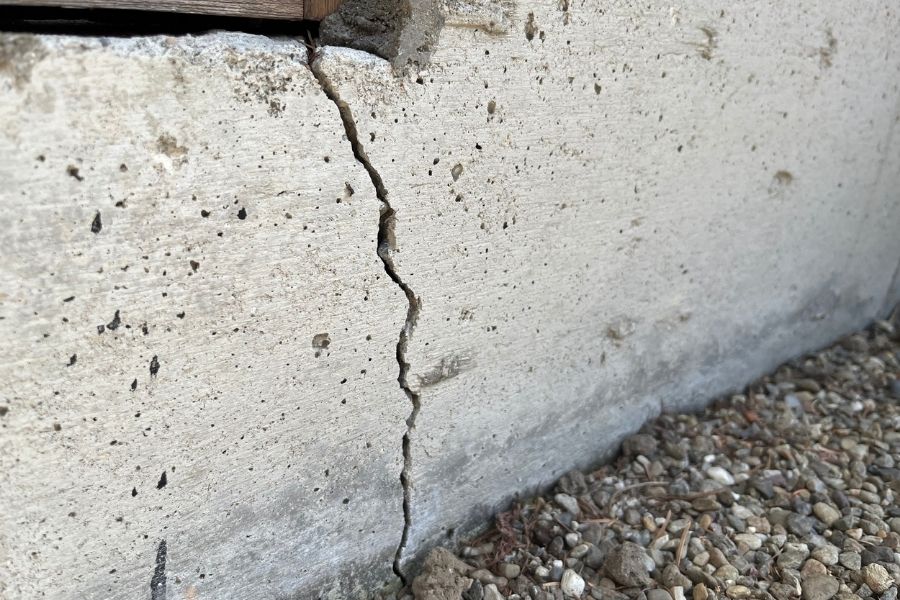
Hairline cracks in garage slabs
Small vertical cracks near foundation corners
Fine cracks in interior drywall above baseboards
Minor gaps between foundation and siding
Cracks wider than 1/4 inch
Horizontal cracks in foundation walls
Stair-step cracks in brick or block
Cracks leaking water after rain
Cracks with visible offset or displacement
Foundation cracks in Austin typically worsen in late summer (August–October) when drought stress peaks. Cracks may partially close during winter rains and reopen the following summer—an indication of active foundation movement.
Less than 1/8 inch wide
No widening over time
No doors sticking or floor movement
Seal and monitor annually.
1/8 to 1/4 inch wide
Seasonal widening
Minor functional issues
Professional evaluation recommended.
Wider than 1/4 inch
Horizontal cracks
Cracks with offset
Water intrusion
Require immediate structural assessment.
Monitoring Tip: Mark crack ends with a pencil and date them. Growth over time indicates active movement.
Trustindex verifies that the original source of the review is Google. Great Service!!Trustindex verifies that the original source of the review is Google. Quick and fast i reccomend thisGoogle rating score: 5.0 of 5, based on 7 reviews
Best for stable cracks under 1/4 inch. Epoxy or polyurethane injection seals cracks and prevents moisture intrusion.
Used for cosmetic or non-structural cracks, especially in visible areas.
Required when cracks result from ongoing foundation movement. Stabilization must occur before cracks are permanently repaired.
Professional Assessment Is Critical
Because Austin’s clay soil causes ongoing movement, crack repair without stabilization often leads to recurring damage. Austin Expert Foundation Repair provides free inspections to determine the correct solution.
Foundation watering: Maintain consistent soil moisture during drought
Drainage control: Extend downspouts 5+ feet from foundation
Tree management: Monitor large trees near foundations
Annual inspections: Check cracks every fall after summer drought
Early intervention: Address small cracks before they worsen
While prevention reduces severity, Austin’s soil conditions mean cracks may still occur over time.
Minor crack repair: $500–$2,000
Moderate repairs: $2,500–$6,000
Major structural repair: $7,000–$15,000+
Costs depend on soil depth, foundation type, and severity. Early repair is always less expensive than delayed stabilization.
Round Rock & Pflugerville
Deep clay deposits cause slab cracking and settlement in newer homes.
Cedar Park & Leander
Rapid development over expansive clay leads to slab and garage floor cracking.
Buda & Kyle
Clay-rich soil and drainage challenges contribute to widening foundation cracks.
West Lake Hills & Bee Cave
Shallower clay over limestone reduces frequency but still causes stress-related cracking.
Schedule a professional inspection if you notice:
Cracks wider than 1/4 inch
Horizontal or stair-step cracks
Cracks leaking water
Doors or windows sticking near cracked areas
Austin Expert Foundation Repair provides free, no-obligation foundation inspections throughout Austin and surrounding areas. Our specialists identify the cause of foundation cracks and recommend long-term solutions tailored to Austin’s soil and climate conditions.

Some are cosmetic, but cracks wider than 1/4 inch or horizontal cracks indicate structural movement.
Taylor Black Clay soil shrink–swell cycles, drought, heavy rain, trees, and plumbing leaks.
Yes. Austin’s seasonal soil movement is progressive.
Usually not, unless caused by a covered plumbing failure.
Yes, but disclosure and proper repair protect value.
Minor cracks can be monitored, but widening or leaking cracks require prompt evaluation.
Austin Expert Foundation Repair provides free, no-obligation foundation crack inspections throughout Austin and nearby communities. Our specialists evaluate crack type, width, location, and movement patterns while assessing soil conditions, drainage, and foundation design unique to Central Texas homes.
Schedule your free foundation crack inspection today and get clear answers from a local Austin foundation specialist you can trust.
Provide your name, phone number, and any specific service requirements.